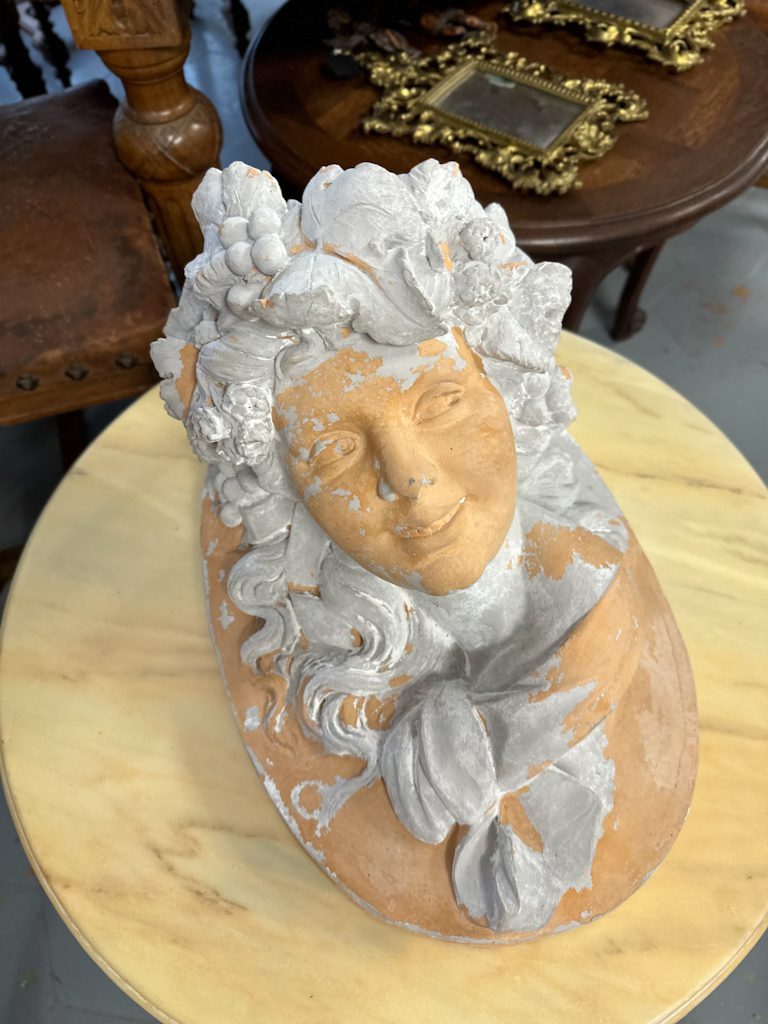
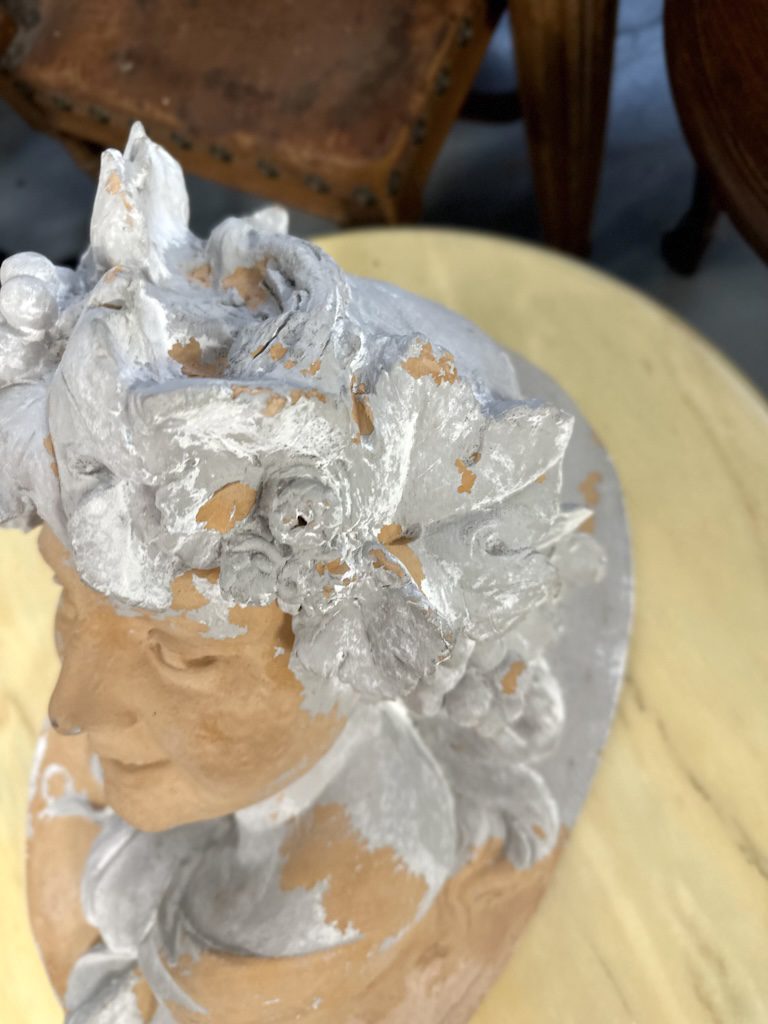
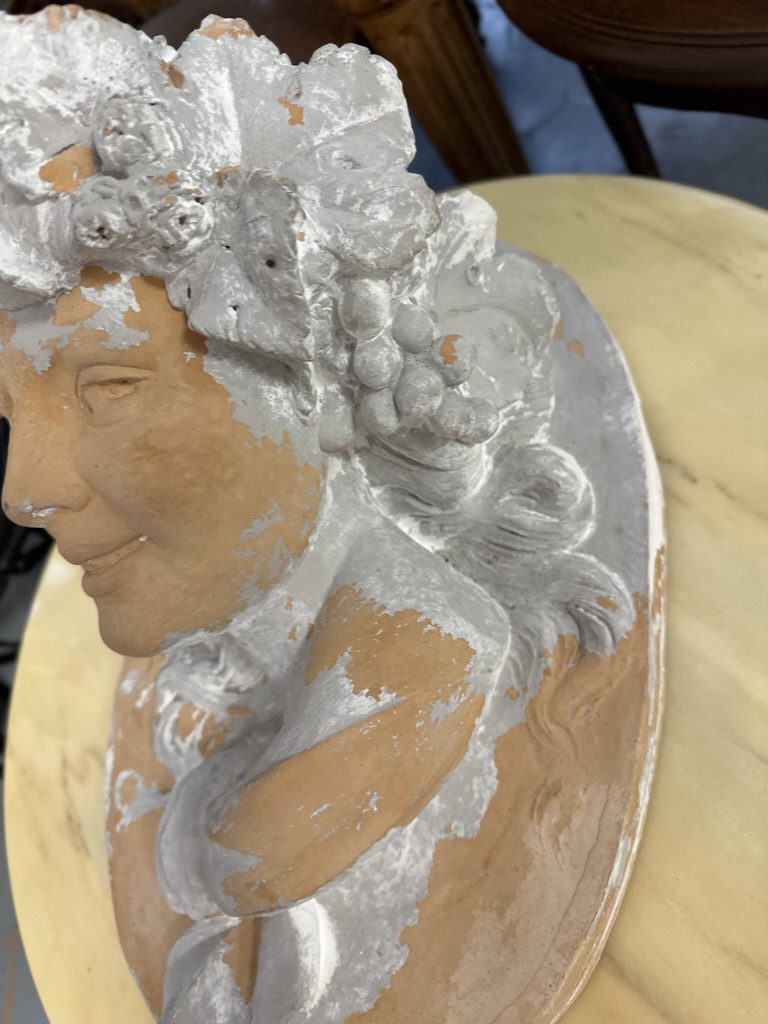
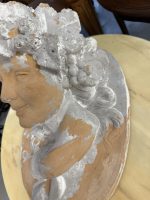
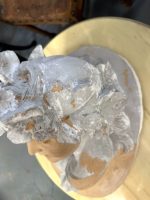
A terracotta female bust with a vine wreath, Art Nouveau — France/Italy, circa 1890–1910. This piece embodies the organic style of the era, with flowing hair and grape motifs, reminiscent of Bacchante or Pomona iconography. The textured, two-tone finish adds to its visual appeal. 350,00 €
You’re now subscribed to price tracking for this product. We’ll notify you if the price drops. 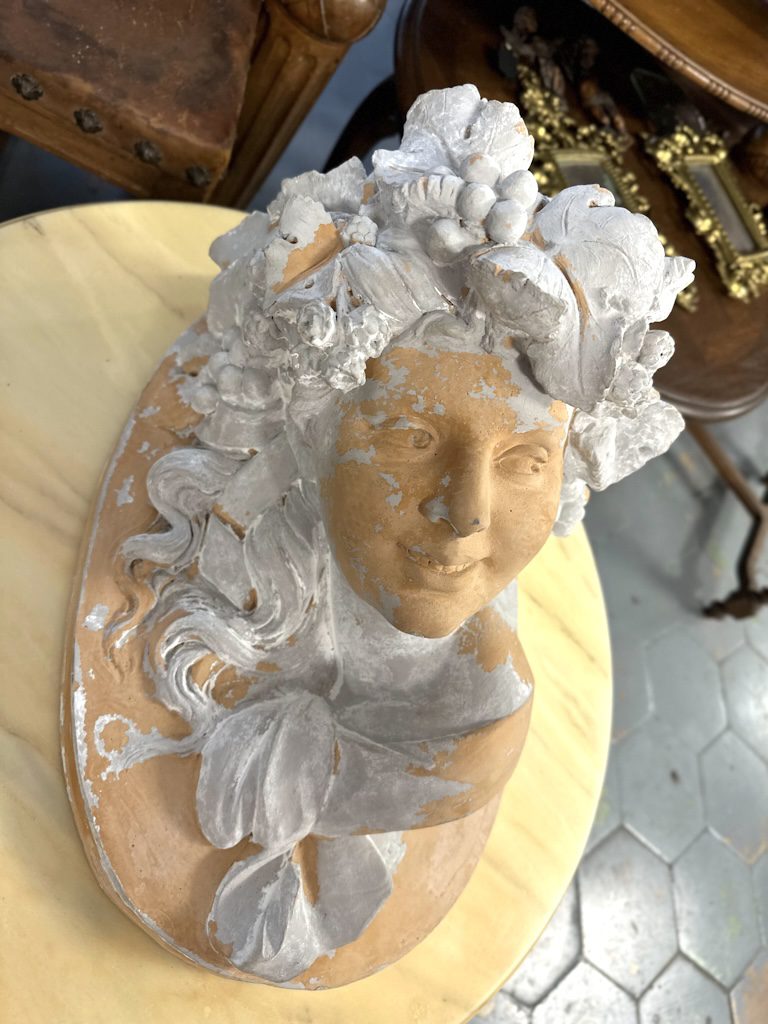
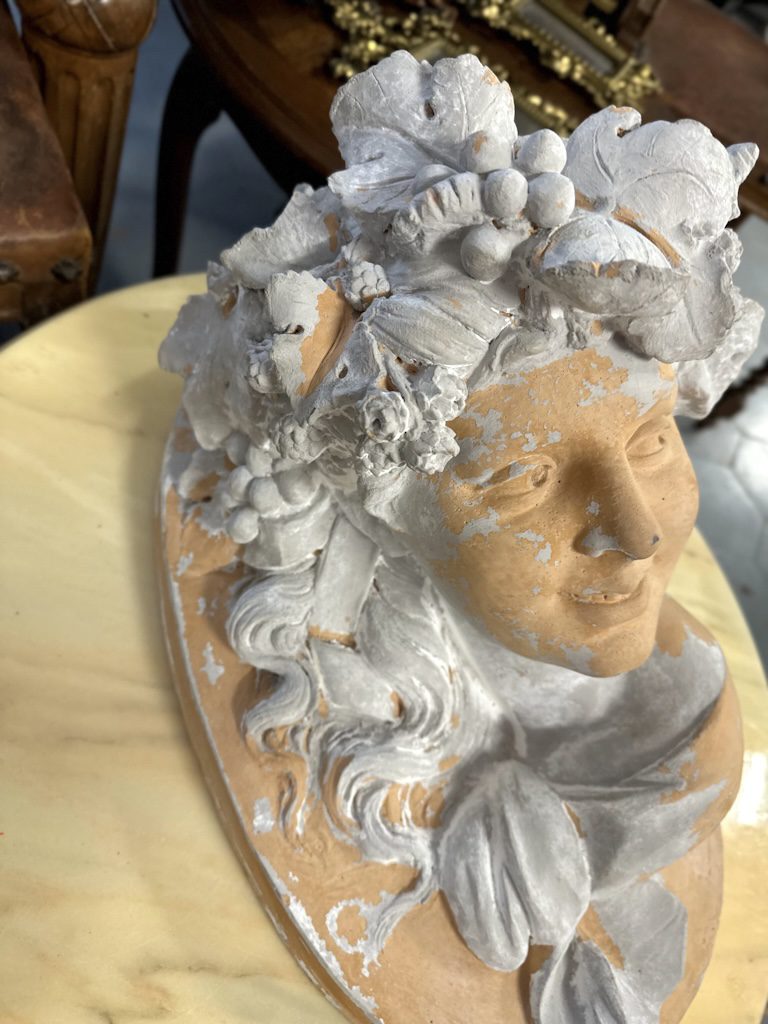
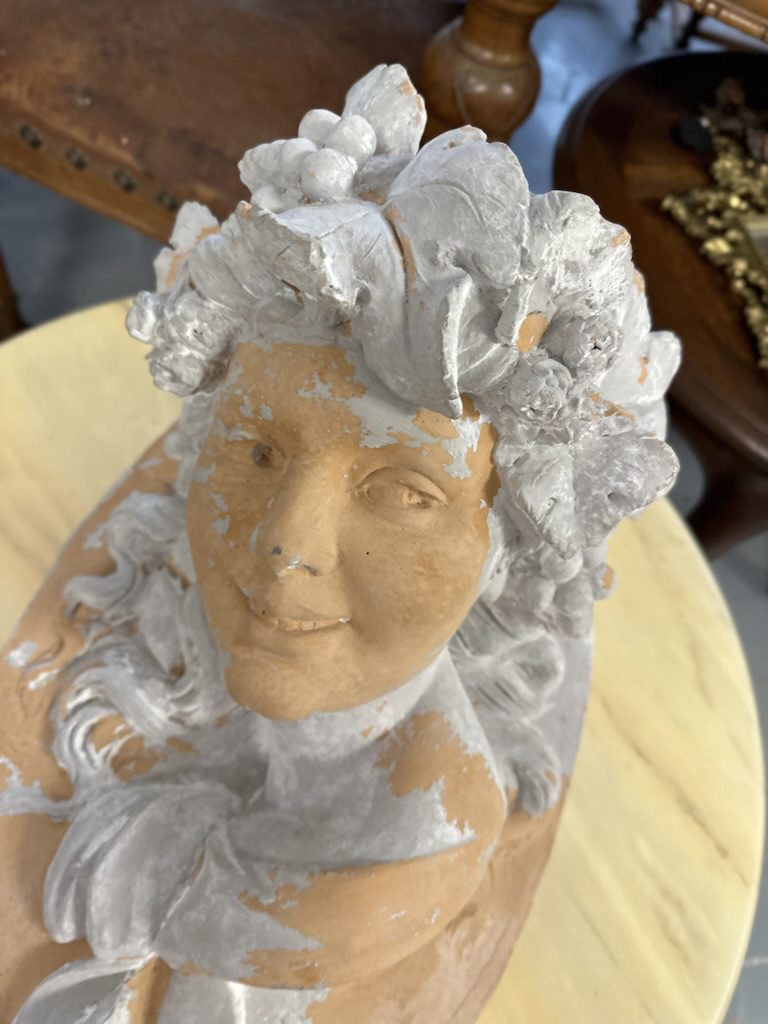
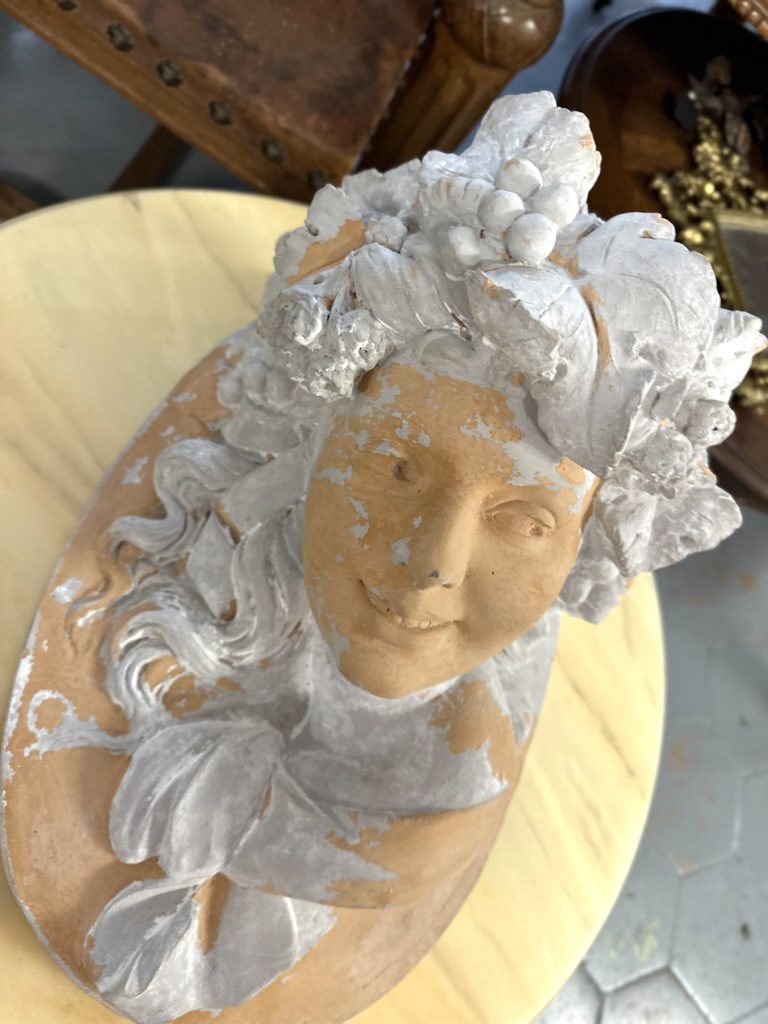
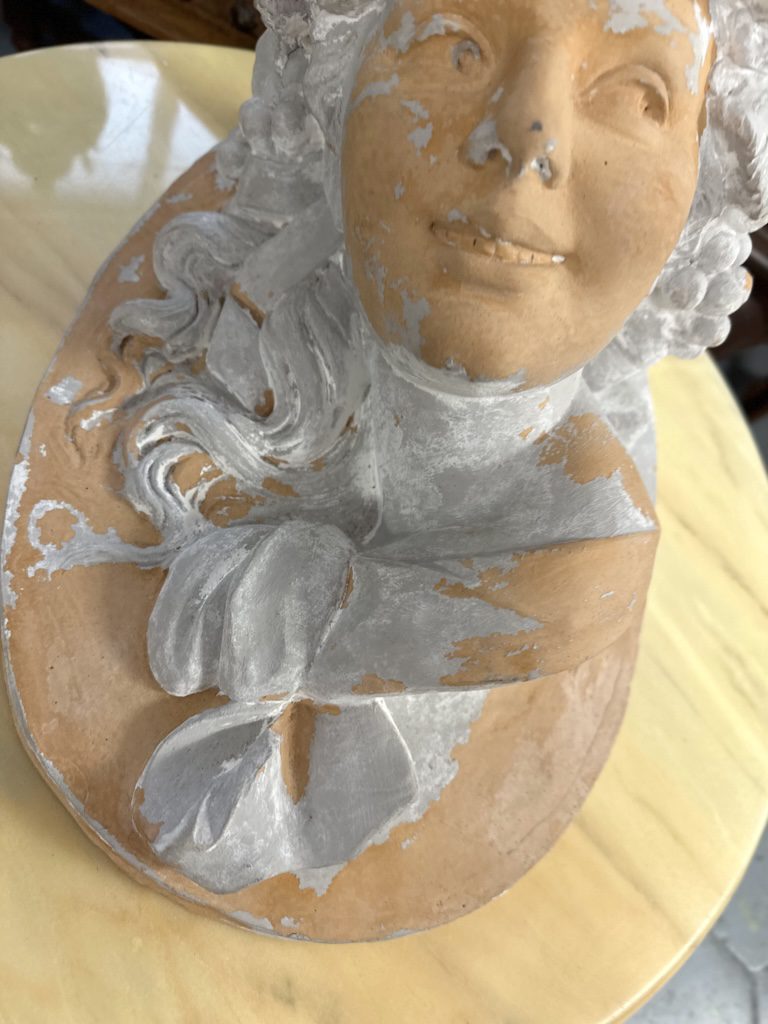
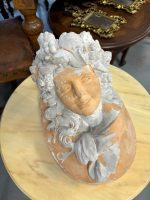
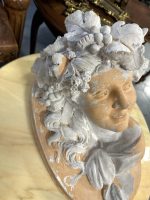


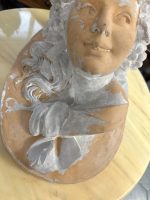
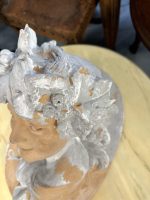
Dekors – Woman’s Bust with Grapevine Wreath – Terracotta, Art Nouveau, France/Italy, 1890–1910 (4487)
Height 43 cm Width 29 cm Color NaturalOrangeTerracotta


Description
Female Bust with Vine Wreath — Terracotta, Art Nouveau, France / Italy, circa 1890–1910
Art Nouveau period snapshot: In October 1900, Alphonse Mucha returned to Paris after visiting the World Exhibition and stopped at a newspaper kiosk on the boulevard. He bought two copies of La Plume, tucked them under his arm, and walked on — past a portal façade where a terracotta female head with a vine wreath was set between ornamental branches, the kind seen at every turn in this city. He did not glance at it. But a week later, precisely that face appeared in his new sketch.
This wall-mounted bust was created during the height of Art Nouveau, when decorative art abandoned the rigid vocabularies of Historicism for the organic language of nature. A woman’s face, grape clusters, vine leaves, freely flowing hair — the central symbols of the movement, present equally in Mucha’s posters, Klimt’s gilded canvases, and Rodin’s marbles. Terracotta experienced a renaissance in this era: its warm orange-brown tone evoked ancient Italy, earth, and abundance.
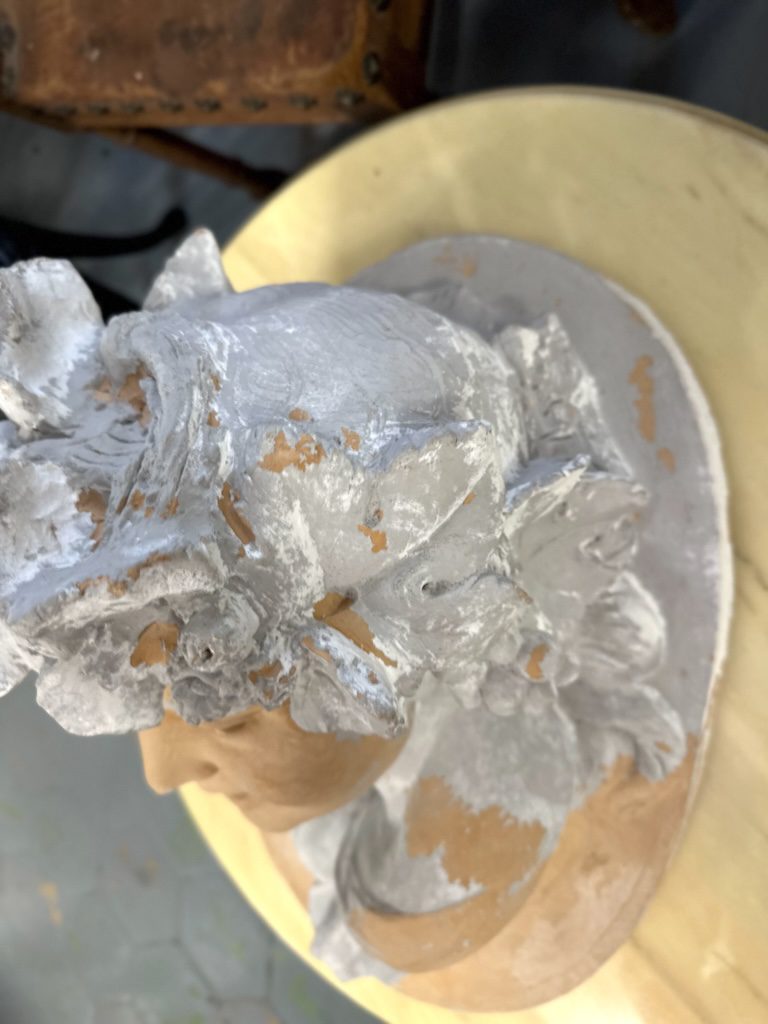
The bust is modelled as a wall decoration on an oval terracotta plaque, with the face and shoulders projecting three-dimensionally. The vine wreath and flower garland suggest the iconography of Bacchante or Pomona — the female figure as symbol of harvest and plenty. The surface carries a partially worn grey-white lime wash over the natural terracotta ground, creating a two-tone textural effect that reads as the piece’s visual identity rather than damage.
No maker’s mark is present — typical of architectural terracotta ornament mass-produced by competing and Italian workshops. The quality of modelling suggests professional manufacture, possibly as part of a larger architectural ensemble.
The condition of the item is fully reflected in the photographs.
Höhe: ~43 cm. Breite: 29 cm. Tiefe: 27 cm.
Buste féminin à la couronne de vigne — terre cuite, Art Nouveau, France / Italie, vers 1890–1910
Instantané de l’époque Art Nouveau : En octobre 1900, Alphonse Mucha rentra à Paris après sa visite de l’Exposition universelle et s’arrêta à un kiosque à journaux sur le boulevard. Il acheta deux numéros de La Plume, les glissa sous le bras et continua — passant devant un portail dont l’ornementation accueillait une tête féminine en terre cuite couronnée de vigne, comme on en voit à chaque pas dans cette ville. Il ne la regarda pas. Mais une semaine plus tard, exactement ce visage apparaissait dans son nouveau croquis.
Ce buste mural fut créé au cœur de l’Art Nouveau, quand l’art abandonnait les formes rigides de l’Historicisme pour le langage organique de la nature. Visage féminin, grappes de raisin, feuilles de vigne, chevelure libre — symboles centraux du mouvement, présents aussi bien dans les affiches de Mucha que sur les toiles de Klimt. La terre cuite connaissait une renaissance en cette époque, son ton chaud évoquant l’Italie antique, la terre et l’abondance.
Le buste est conçu comme décoration murale sur une plaque ovale en terre cuite, le visage et les épaules se projetant en trois dimensions. L’iconographie — couronne de vigne, fleurs, ruban — renvoie à la Bacchante ou à Pomone, la femme comme symbole de la récolte. La surface porte un badigeon gris-blanc partiellement écaillé sur le fond naturel de terre cuite, créant un effet bichrome qui constitue l’identité visuelle de la pièce.
L’état de la pièce est entièrement reflété dans les photographies.