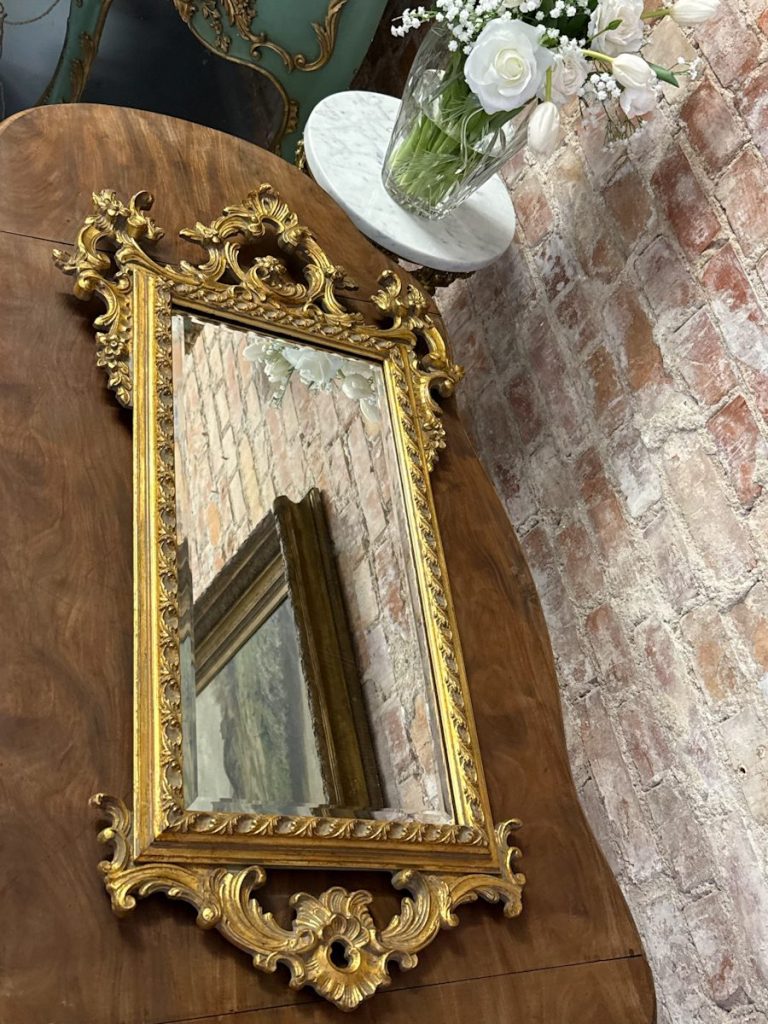
This magnificent, structurally impressive, and extremely heavy antique gilded mirror is a striking monument to late 19th-century French decorative art and furniture making, dating from around 1875–1890. Crafted in the highly sought-after “cushion frame” architectural configuration (glace à… 980,00 €
You’re now subscribed to price tracking for this product. We’ll notify you if the price drops. 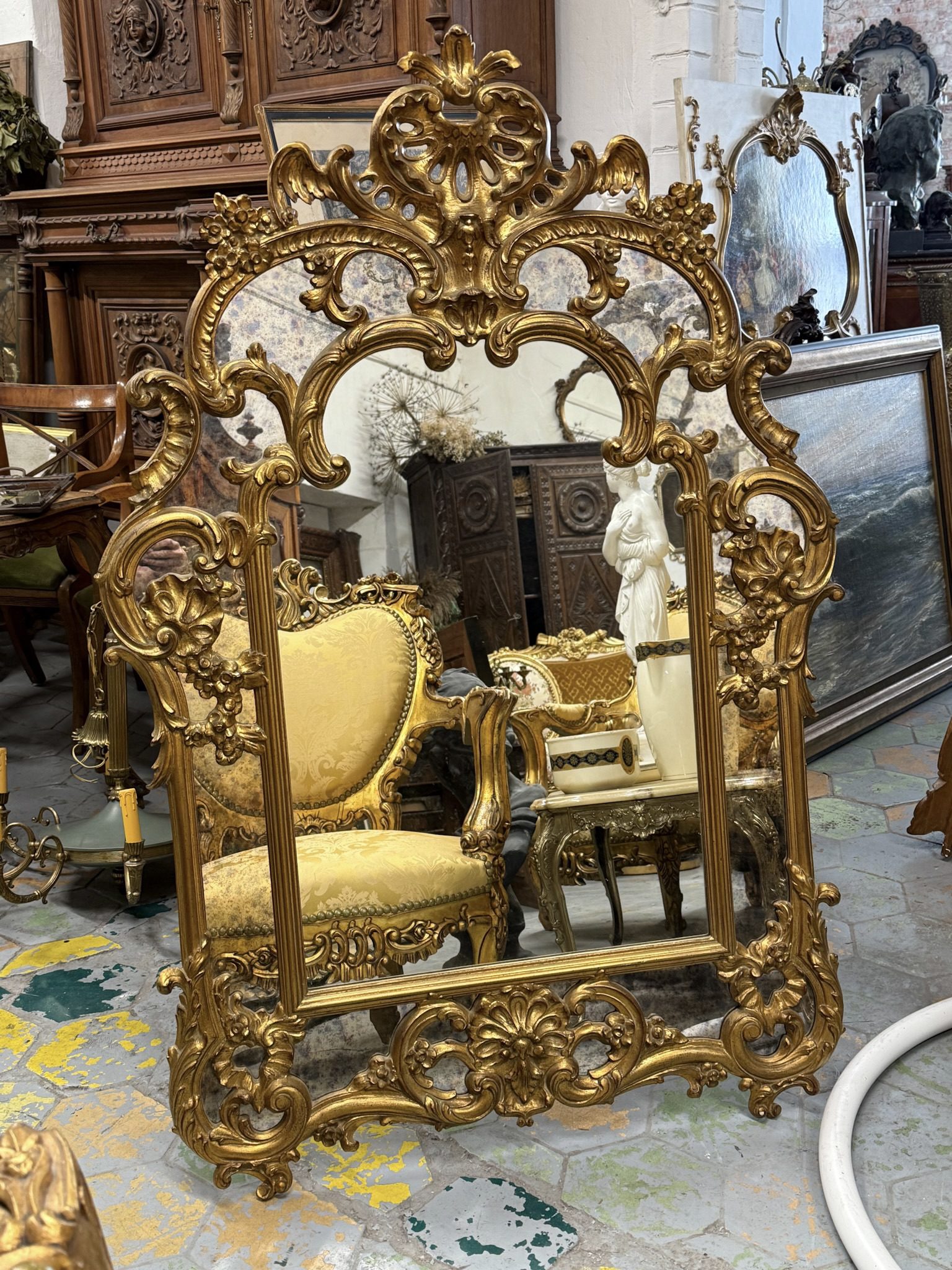
Monumental Gold Gilt Wall Mirror with Ornate Pierced Crown – Second Half 19th Century (5970)
Height 144.5 cm Width 97.5 cm Color BronzeNaturalMulti
Description
DIMENSIONS:
-
Height: 144.5 cm
-
Width: 97.5 cm
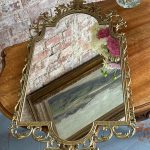
Magnificent, palace-scale Rococo-style gilded mirror with double glass frame and massive openwork rocaille crown — second half of the 19th century
Luxurious, monumental-sized Rococo-style gilded wall mirror with an impressive openwork crown — late 19th century
This monumental-scale, exceptionally wide, and impressively heavy antique gilt mirror is an outstanding monument of late 19th-century European furniture art and academic design. The item represents a special and highly valued type in the antique mirror segment — the so-called cushion-type mirror with a double frame (cushion mirror or glace à parcloses). Its construction is based on a central rectangular mirror glass, separated from the ornate, sculpturally cast, and cut frame by an additional narrow, beveled perimeter of mirror glass. This multi-layered structure provides a grandiose effect of light refraction and reflection, lending the room unusual depth, luxury, and spaciousness. The frame’s surface has retained its magnificent, deep gold color sheen, naturally complemented by the noble matte patina acquired over time in the relief grooves and woven ornaments.
The artistic substance of the frame is defined by the exquisite canons of Louis XV and Rococo style (Rococo Revival) design, executed with maximum sculptural power. The top of the frame is crowned by a massive, fully openwork pierced cresting (cresting), featuring a large, perforated, and deeply grooved rocaille shell in its center. From it, voluminous acanthus leaf volutes extend to both sides, transitioning into dense, three-dimensional field flower clusters. The side edges and corners of the frame are enriched with equally expressive, undulating volutes and floral rosettes, while the lower part of the frame, or apron, is finished with a magnificent pierced base with a rhythmic acanthus leaf medallion in the center. Each strip of the frame containing additional mirror glass inserts is accented with a delicate, chased profile.
Significantly, all mirror glass elements — both the large central glass and all the surrounding inserts of the crown and base — have retained their historical structure with a gentle patina of time. The construction is securely and reliably enclosed at the back by a monolithic historical wooden protective plate, ensuring complete stability and guaranteeing the item’s pristine antique construction.
PERIOD OF MANUFACTURE, ARTISTIC STYLE, ERA Manufactured approximately between 1875–1890, in France. The item represents the magnificent and ambitious flourishing of the late style of the Napoleon III period, when a huge fashion trend for monumental, palace-scale gilded interior objects prevailed throughout European high society. Mirrors of this execution glace à parcloses were made as main representative objects for grand salons, to be placed above marble fireplace mantels or on central wall planes between tall windows, demonstrating the high social status and academic taste of the homeowners.
Snapshot of the era: In the flourishing period of Napoleon III and late Historicism, a tense, solemn, and musically expectant atmosphere prevailed in the reception salon of the Parisian apartment of the famous composer Charles Gounod. The most distinguished artists and opera singers of the time gathered in the room, and sunbeams gently illuminated the gilded silk furniture and the polished wood of the grand piano. On the wall above a luxurious console hung a large, heavy gilded mirror, whose clear surface and additional glass frame strips beautifully reflected the splendor of the entire salon and the flames of burning candles. The composer paused for a moment, observing how the evening light reflections shimmered on the openwork acanthus leaves of the frame and the massive rocaille crown, making every facet of gold sparkle. In the interiors of that time, such a harmonious and palace-scale object was not simply glass — it was an intelligent visual backdrop that brought complete academic elegance and aristocratic grandeur to any creative space.
MANUFACTURER AND ORIGIN The impeccable symmetry of the openwork crown structure, the sharpness of the rocaille, and the rhythmic beadwork along the glass edges unequivocally point to the leading Parisian furniture and decorative frame workshops (ateliers parisiens) that worked to the highest academic standards in the late 19th century, supplying elite European interior salons.
RARITY AND SIGNIFICANCE While simpler rectangular frames appear relatively regularly in the antique segment, a monumental mirror of this caliber with a double glass frame (à parcloses) and a fully preserved, highly elaborate openwork rocaille crown is a rare and sought-after find. Such fragile, protruding openwork elements and narrow glass strips were most often irreversibly broken during daily use and transportation, hence the item’s complete structural preservation and authenticity determine its high cultural-historical substance.
APPLICATION IN INTERIOR AND DESIGN The mirror will serve as a grandiose, dominant, and instantly noticeable visual and architectural centerpiece in any spacious room. It occupies an ideal place for placement in a representative hallway, a large living room above a console, a private library, or an art gallery. Thanks to its large surface area and multi-layered glass frame, it fantastically captures, refracts, and multiplies the room’s light from various angles, making it an excellent object for high-level interior design photography.
CONDITION The mirror is in excellent antique condition. The massive and heavy frame is completely rigid, straight, and monolithic. All ornate decorative elements — the upper openwork crown with the shell, the side floral pendants, and the lower apron — are in their original and completely intact form, without structural breaks or signs of modern restoration. The gold-colored surface has retained its magnificent, deep sheen and natural historical patina. The central mirror glass and the surrounding strips are firmly fixed, in excellent condition, with minimal and natural accents of historical amalgam aging, which only enhance the item’s authenticity and true age. The historical wooden backing is fully functional and secure.