Antique 3-piece carving set with silver handles — late 19th century. This exquisite French set features a knife, fork, and unique gigot holder, all with ornate silver handles in a Louis XVI style. Presented in its original burgundy velvet-lined case,… 300,00 €
You’re now subscribed to price tracking for this product. We’ll notify you if the price drops. 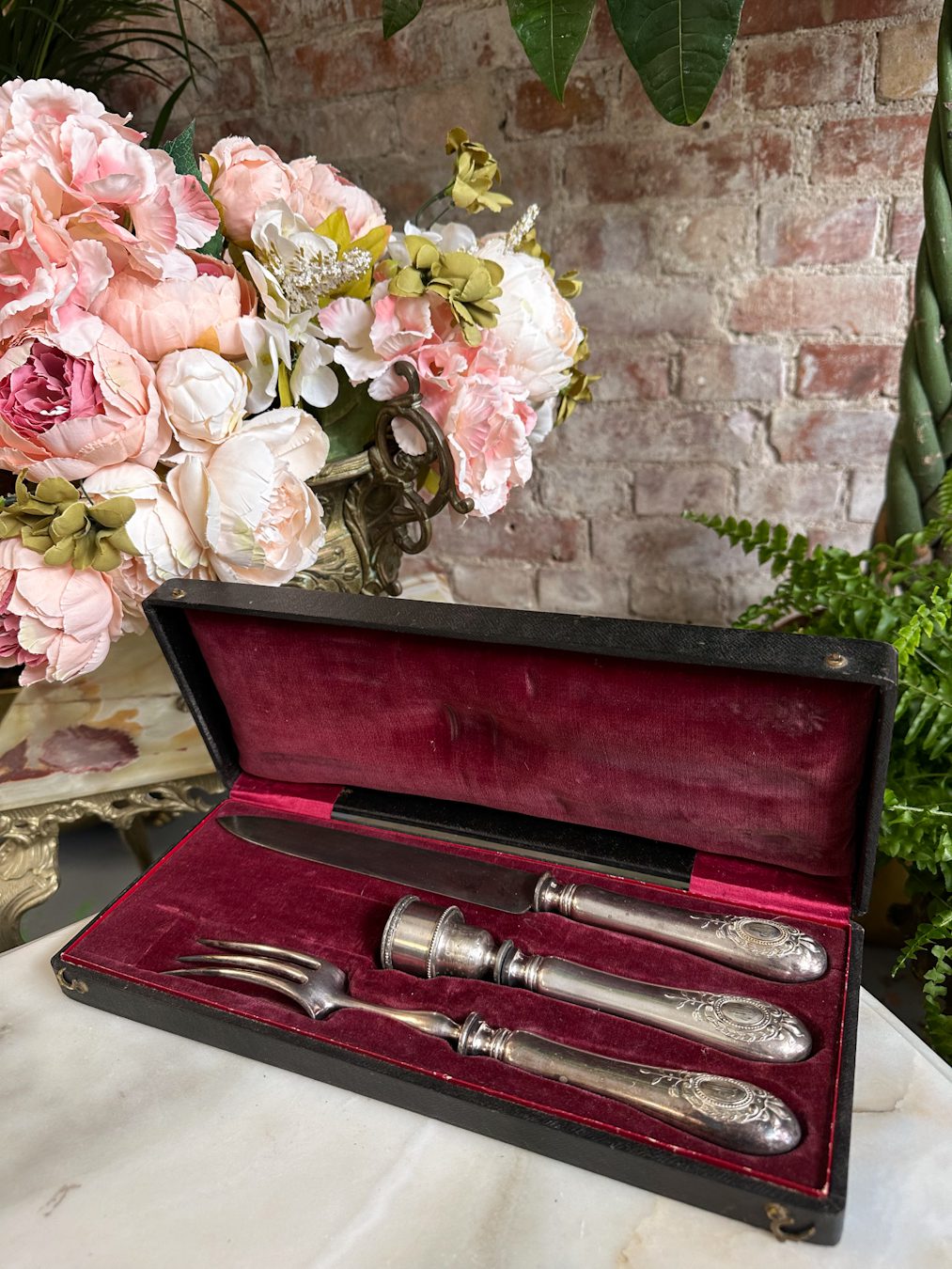
Antikt 3-delt stegebestik sæt med sølvgreb i kasse – slutningen af 1800-tallet (4953)
Farve NaturMahogniBordeauxrød
Beskrivelse
Полная и расширенная версия на английском языке:
Antique silver carving set — Turn-of-the-century Louis XVI style 3-piece roast meat carving service with silver handles and gigot bone holder in original case
DIMENSIONS:
-
Presentation Box: Fits the complete 3-piece set proportionally.
-
Composition: 3 pieces (1 long carving knife, 1 three-tine meat fork, and 1 mechanical gigot bone holder).
This highly elegant, remarkably rare, and structurally substantial antique silver carving set is a spectacular survival of late 19th-century culinary silver art and formal dining culture, dating to circa 1880–1895. Designed as a comprehensive, elite presentation, the collection features three highly specialized utensils tailored for the art of tableside service: a long carving knife, a three-tine meat fork, and the definitive symbol of Fin-de-Siècle gastronomic luxury—a mechanical gigot holder (or manche à gigot) engineered to firmly clamp onto the bone of a roasted leg of lamb or veal. Executed in the traditional late Historicism and Louis XVI revival taste, the defining character of this masterwork is the regal quality of its heavy, solid silver handles. The perimeter of each handle is deeply embossed with a crisp, detailed relief pattern of classical laurel leaf garlands, stylized acanthus flourishes, and beaded borders. These borders enclose smooth, unengraved oval cartouches on both sides, traditionally left blank for an owner’s custom monogram or family crest. The structural forged steel blades and tines remain firmly mounted into the silver sockets, showing incredible balance in hand.
The service is beautifully preserved within its original, fitted presentation box lined with its historic deep burgundy wine-colored velvet and silk cushioning, featuring precise slots for each individual instrument. Clear silversmith hallmarks and guarantee stamps are crisply struck along the silver handles and collar rings, validating its true age, purity, and pedigree.
Fin-de-Siècle snapshot: During the absolute heights of the grand Belle Époque period, within the elegant Paris salon of a celebrated patron of the arts and close companion to the opera composer Georges Bizet, a stately evening stillness held the space during a formal dinner party. The warm candlelight illuminated the heavy mahogany wall panels and fine porcelain, reflecting beautifully along the matching pieces of the set resting inside the open presentation box upon the side table. As the main course was announced, the host raised the long carving knife and secured the silver gigot holder onto the roast bone; the hand-chased laurel leaf garlands caught the room light, reflecting beams of silver like moonlight dancing on a completely calm, smooth body of water. To visitors of the era, such a substantial apparatus was far more than a practical service; the fine antique silver handles seemed to vibrate with a serene and clement dignity gathered across a century of existence, dissolving into absolute aristocratic harmony.
The antique set remains in outstanding condition. All three individual pieces are structurally straight, tight, and completely solid, showing no movement or looseness at the handles. The heavy silver handles retain an exceptionally crisp relief pattern with a magnificent, deep natural patination within the low recesses that highlights the neoclassical details. The mechanical screw thread of the gigot holder operates smoothly, clamping firmly with absolute security. The original presentation case is fully intact, with its brass hooks locking securely, and the interior burgundy velvet remains vibrant, clean, and beautifully complete.
Полная и расширенная версия на немецком языке:
Antikes herrschaftliches 3-teiliges Tranchierbesteck-Set mit Silbergriffen in Original-Schatulle — Frankreich, um 1890 (4953)
Dieses kunstvoll gestaltete, makellos erhaltene Tranchierbesteck-Set (antique set) mit massiven Griffen aus hochwertigem Echtsilber ist ein exquisites Meisterwerk des französischen Historismus und des Louis-XVI-Stils (ca. 1880–1895). Das absolute Prunkstück dieses Entwurfs ist das seltene Arrangement aus drei Teilen: Einem langen Tranchiermesser, einer dreizinkigen Fleischgabel und dem Prachtstück der feinen Tafelkultur dieser Epoche – einem mechanischen Knochenhalter (gigot holder / manche à gigot), der dazu diente, die Keule eines Lamm- oder Kalbsbratens beim Tranchieren fest zu fixieren. Die silbernen Griffe sind im reinen klassizistischen Stil gearbeitet; ihr Umfang ist mit einem tiefen Relief aus Lorbeergirlanden und Perlbordüren verziert, die ein glattes Wappenmedaillon für Monogramme einrahmen. Das Set ruht in seiner originalen Schatulle, die im Inneren mit königsvornehme, weinrotem Samt ausgekleidet ist, wobei jedes Instrument sein exaktes Bett findet. Die Silberteile tragen die originalen französischen Meisterpunzen.
Momentaufnahme aus der Belle Époque: In der absoluten Blütezeit der Belle Époque herrschte im feierlichen Salon des Pariser Hauses eines berühmten Mäzens und engen Vertrauten des Opernkomponisten Georges Bizet eine intellektuelle, funkelnde Abendstille. Im Raum duftete es nach Kaminholz, frisch zubereitetem Braten und edlem Bordeaux-Wein, und das Licht der Silberleuchter spiegelte sich prachtvoll in den Mahagonischränken. Auf dem Tisch stand die geöffnete Holzkassette, in deren weinroten Samtbetten das Tranchierbesteck glänzte. Die Gäste beobachteten mit Bewunderung, wie die reliefierten Lorbeerkränze beim Aufnehmen der Messer das Licht ablenkten und widerspiegelten, so als ob eine Mondnacht auf die glatte Oberfläche eines stillen Gewässers fiel. In der Kultur dieser Epoche war ein solch harmonisches Set eine erstarrte visuelle Poesie — das Silber der Griffe schien mit einer herrschaftlichen und clementen Würde aus Jahrhunderten zu vibrieren und brachte vollendete französische Eleganz in den herrschaftlichen Raum.
Das Set befindet sich in einem hervorragenden Originalzustand. Alle drei Teile sind vollkommen stabil und gerade, die Silbergriffe sind spielfrei montiert, und das Relief zeigt makellose Schärfe mit einer tiefen, natürlichen Alterspatina. Die Stahlklingen und Zinken sind robust und frei von tiefer Korrosion. Das Schraubgewinde des Knochenhalters greift flüssig, fest und sicher. Die Schatulle schließt perfekt mit ihren originalen Messinghaken, und das weinrote Samtfutter ist sauber und farbfrisch erhalten.
Полная и расширенная версия на французском языке:
Somptueux service à découper le gigot d’époque Historicisme en argent massif et acier, 3 pièces — France, vers 1890 (4953)
Ce magnifique, très important et particulièrement rare service à découper la viande est une magnifique pièce de maîtrise de l’orfèvrerie e de style Louis XVI de la fin du XIXe siècle, vers 1880–1895. Conçu selon un modèle d’une grande distinction pour les grands dîners, cet ensemble exceptionnel comprend 3 pièces de haute qualité : un long couteau à trancher, une fourchette à viande à trois dents et la pièce maîtresse de la gastronomie de la Belle Époque — un manche à gigot mécanique (gigot holder), destiné à enserrer fermement l’os de la pièce de rôti lors de la découpe. Chaque pièce est rehaussée d’un lourd manche en argent massif fourré, déployant un délicat décor de style néoclassique entièrement ciselé de guirlandes de laurier, de frises d’acanthe et de rangs de perles. Ces bordures encadrent des cartouches ovales lisses sur les deux faces, laissés libres pour y graver des armoiries ou monogrammes. L’envers des viroles et les manches frappés portent les poinçons de garantie et de maître-orfèvre . L’ensemble est présenté dans son précieux écrin d’origine gainé de noir, tapissé à l’intérieur de son rare velours de soie bordeaux d’origine.
Instantané de la Belle Époque : En plein apogée de la Belle Époque et de la haute gastronomie e, dans le salon d’apparat parisien d’un illustre mécène et proche compagnon du compositeur d’opéra Georges Bizet, un calme soir de réception, vibrant de discussions artistiques, enveloppait la pièce. Le salon embaumait le feu de cheminée, le gigot d’agneau rôti et le grand bordeaux, tandis que la lumière des candélabres scintillait magnifiquement sur les buffets en acajou et les porcelaines fines. Sur la table, le coffret d’origine était grand ouvert, révélant ses loges de velours bordeaux où brillaient les couverts à découper. Les convives admiraient avec émerveillement comment les motifs de laurier en argent massif détournaient et projetaient la lumière, à la manière d’une nuit de l’une se reflétant sur l’eau parfaitement calme et lisse d’un lac tranquille. Dans les décors de l’époque, un tel service d’apparat n’était pas une simple ménagère : l’argent ancien des manches semblait vibrer d’une dignité sereine et clémente accumulée au fil d’un siècle d’existence, apportant une élégance académique parfaite et une majestueuse harmonie à l’art de la table .
Ce service de 3 pièces est dans un état de conservation d’origine remarquable. Tous les couverts sont parfaitement sains, rigides et stables, sans aucun jeu aux manches en argent massif. Les reliefs n’ont subi aucune altération, affichant une superbe patine naturelle dans les détails. Les parties en acier forgé sont propres, sans corrosion profonde. Le pas de vis et le papillon de serrage du manche à gigot fonctionnent avec une grande souplesse, assurant un serrage ferme et sécurisé. Le coffret est robuste, les crochets en laiton d’origine fonctionnent parfaitement, et le velours bordeaux intérieur a précieusement conservé tout son éclat et sa fraîcheur d’époque.