Cast iron coal stove with mask and lid — Corneau Frères, Charleville, Napoleon III style, second half of the 19th century This impressive coal stove (cast iron coalbox) — boîte à charbon — is a magnificent work from the Napoleon… 430,00 €
You’re now subscribed to price tracking for this product. We’ll notify you if the price drops. 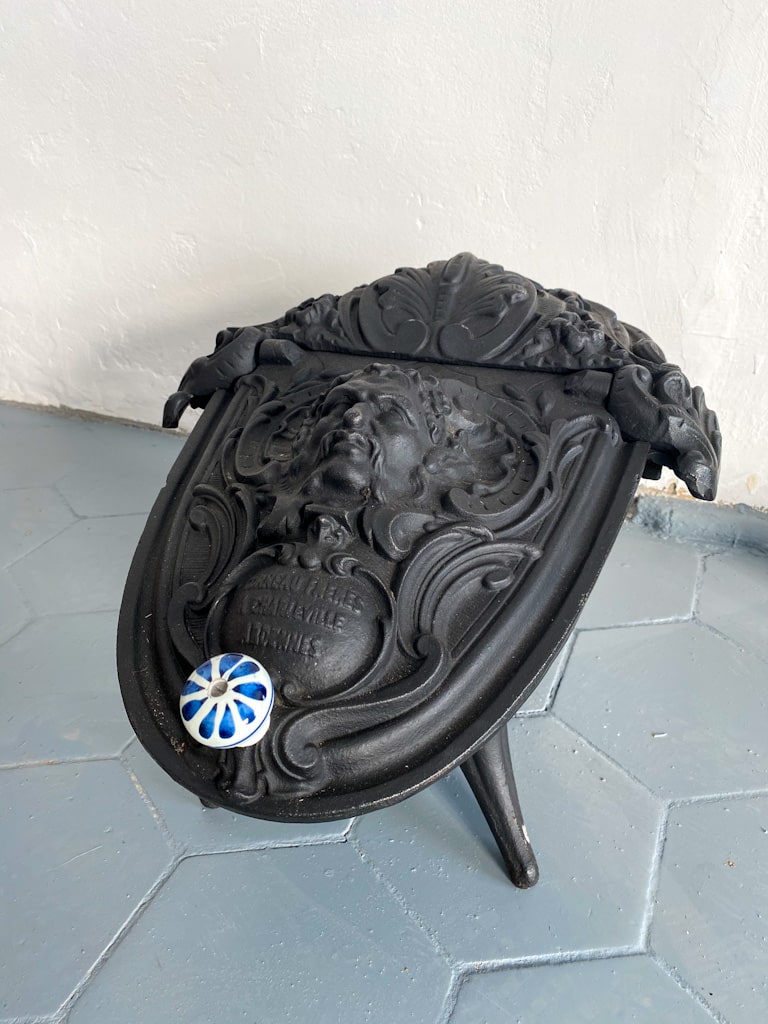
Used cast iron coal box with mask and lid, Corneau Frères (662)
Height Length 54 cm Width 38 cm Color WhiteBlackBlue
Description
Cast iron coal stove with mask and lid — Corneau Frères, Charleville, Napoleon III style, second half of the 19th century
This impressive coal stove (cast iron coalbox) — boîte à charbon — is a magnificent work from the Napoleon III period, marked with the seal of the renowned foundry Corneau Frères. Here, coal was stored by the fireplace, from which it was added to the fire with a shovel; the decorated lid protected against dust and contributed to the salon’s appearance. The stove consists of a deep oval container with a hinged, curved lid, adorned with a fan of acanthus leaves and a floral wreath; in the center — an expressive face of a bearded maskaron (bahantes / a wild man with vine leaves) in a frame of winding rocaille volutes. A blue-white porcelain knob serves to lift the lid; the stove rests on three legs.
Height 37 cm × width 38 cm × length 54 cm
Production period, art style, era. The stove is dated to the second half of the 19th century, the Napoleon III period, when decorative production flourished in France. The maskaron, acanthus, and rocaille motifs reflect a revival of Rococo and Renaissance, typical of art from this time. Even such an everyday object as a coal stove was made as a work of art, to stand worthily next to the salon fireplace.
A snapshot from the Second Empire: a maid in a house in Charleville late in the evening lifted the porcelain knob of the stove and took out the last coals with a shovel for the evening fire. The maskaron’s bearded face flickered in the fireplace’s reflection, almost alive. Outside the window, snow fell silently on the cobblestones. She closed the lid — and only crackling fire and the warmth of remained in the room.
Manufacturer and stamp. The item bears the inscription “Corneau Frères à Charleville, Ardennes”. The foundry was founded in 1846 by brothers Alfred (1825–1886) and Émile (1826–1906) Corneau; from 1859 they specialized in the production of beautiful objects — umbrella stands, benches, vases, heating and household items in — and by the late 1890s, they had about 300 employees. Later, the company was transformed into the famous Deville factory. The stamp dates this stove to before 1886/1890.
Rarity and significance. Marked Corneau Frères coal stoves with preserved original lid, maskaron, and porcelain knob are a valuable discovery today — lids and parts often disappear, and the rusts. An identifiable manufacturer’s stamp gives the item a documented origin.
Use in interiors, design, and photography. The stove serves as a decorative accent by the fireplace; today it can be used for storing firewood, magazines, plants, or garden equipment. Its dark and maskaron create a dramatic, photogenic detail in interior photography.
Gift. An impressive gift for fireplace owners, antique or art enthusiasts, and collectors.
Condition. Preserved body, lid, maskaron, manufacturer’s stamp, and porcelain knob; possible traces of corrosion, wear on varnish, or minor retouching consistent with age and function. The condition of the item is fully reflected in the photographs.