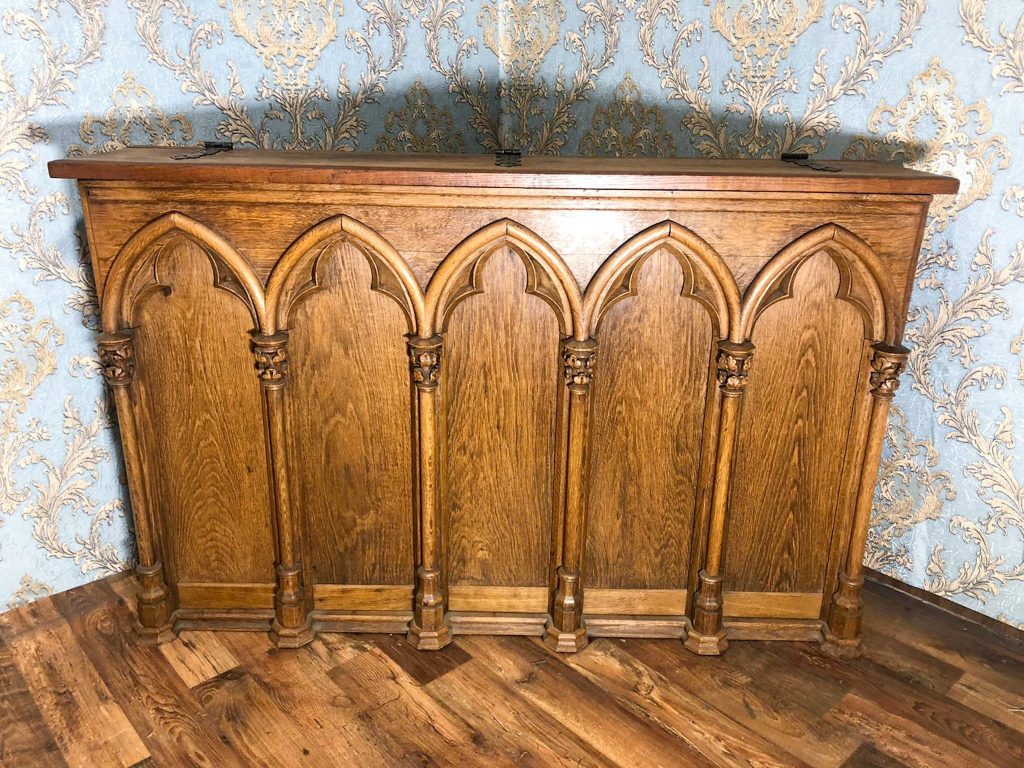
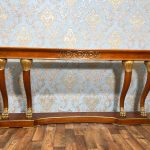
Impressive, very heavy solid oak console-pedestal with a six-column architectural motif. Historicism / Neo-Renaissance style, late 19th century – early 20th century. Strict classical form — Tuscan columns on a stepped plinth. 950,00 €
You’re now subscribed to price tracking for this product. We’ll notify you if the price drops. 
Solid oak console with columns, Historicism / Neo-Renaissance style (548)
Height 113 cm Width 90 cm Color GoldBrownBlue
Description
Dimensions:
SET:
Height: 113 cm
Width: 90 cm
Solid oak console with columns — Historicism / Neo-Renaissance style
An impressive and very heavy oak console-pedestal (oak column console), whose form is defined by a pure architectural motif: a profiled, stepped rectangular surface supported by six round columns rising from a massive, stepped profiled plinth. This is the language of Historicism and Neo-Renaissance style — an era when furniture consciously borrowed the language of antique and Renaissance architecture, transferring the temple and palace to the living space.
The columns are smooth, with simple Tuscan type capitals and rounded bases — restrained, without excessive ornamentation, with an emphasis on proportion and the nobility of the material. The surfaces and plinth boards show expressive oak grain and characteristic ray pattern, which gives solid oak depth and a warm tone. The construction is strong, heavy and substantial — made to last for generations.
A snapshot of the Historicism era: Gottfried Semper, returning to his workshop after a long day on the construction site, placed his hat on the nearest flat surface and stood for a moment, letting his gaze sweep over the six verticals that cast long shadows across the floor. The evening light in the oak highlighted each annual ring as if on a cross-section plan. He ran his thumb over the rounded edge of the capital — the same form he had drawn a thousand times on paper, now warm and tangible under his finger. Somewhere inside, he smiled: even a small thing can carry the logic of an entire building.
Period of manufacture. The console dates to the late 19th century – early 20th century, the heyday of the Historicism / Neo-Renaissance style.
Application. A versatile representative item — as a console against a wall in a vestibule or salon, as a pedestal for a sculpture, vase or bust, or as an effective accent in a library and study. The heavy, architectural form gives the space weight and seriousness.
Condition. Good, age-appropriate condition; solid oak with natural patina and grain. The condition of the item is fully reflected in the photographs.