Каминный экран с резьбой по дереву и шёлковой вышивкой — неоренессансный стиль, XIX век Этот изысканный каминный экран (needlework firescreen) соединяет два ремесленных искусства: богатую резьбу по дубу и тонкую ручную шёлковую вышивку (broderie). Это écran de cheminée — передвижной… 550,00 €
You’re now subscribed to price tracking for this product. We’ll notify you if the price drops. 
Kokgriezuma kamīna ekrāns ar zīda izšuvumu, Neorenesanses stils (4397)
Высота 100.5 cm Ширина 75 cm


Описание
Каминный экран с резьбой по дереву и шёлковой вышивкой — неоренессансный стиль, XIX век
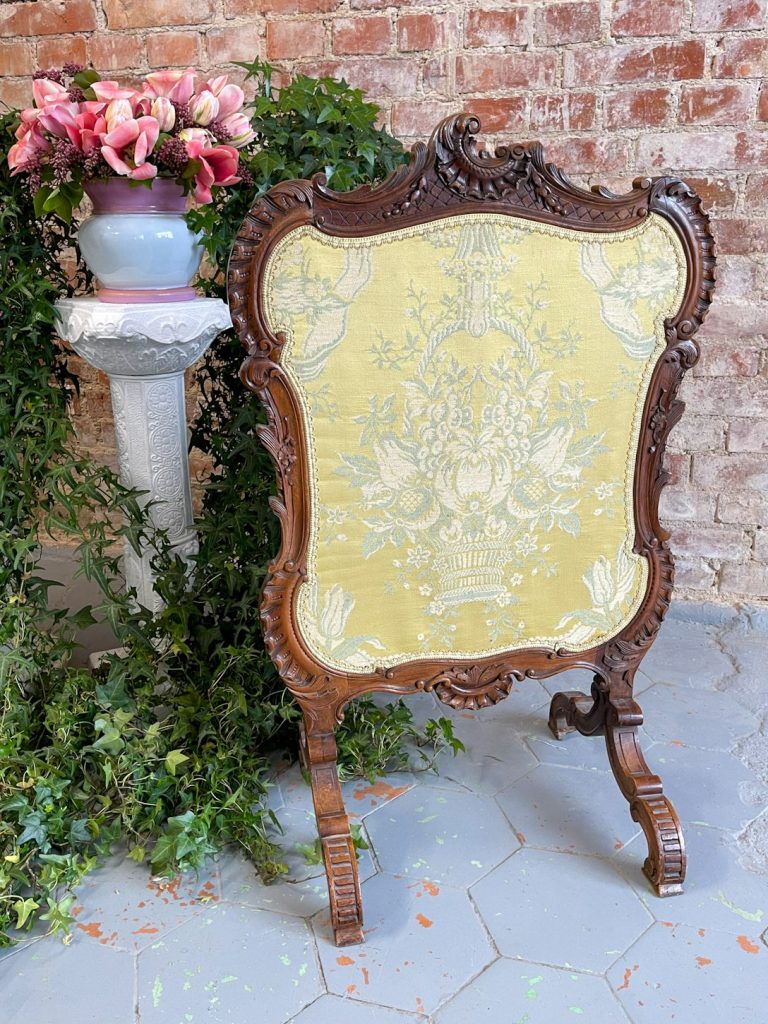
Этот изысканный каминный экран (needlework firescreen) соединяет два ремесленных искусства: богатую резьбу по дубу и тонкую ручную шёлковую вышивку (broderie). Это écran de cheminée — передвижной экран, защищавший лицо от жара огня и одновременно украшавший комнату как произведение текстильного искусства. Верх венчает пышная резная корона с раковиной (coquille) и волютами аканта, по бокам — ажурные волюты, всё опирается на точёные стойки и изогнутые ножки с резной перекладиной.
Высота 100,5 см · ширина 75 см · глубина 29 см
В центре панели — тонкая многоцветная вышивка на светлом шёлке: молодая женщина в наряде моды 1830-х годов и широкополой шляпе, играющая на гитаре, в окружении цветочных ваз, гирлянд и орнамента rocaille. Над ней — голова ангела (херувима) между крыльями, чьё лицо написано красками по ткани — характерная техника ранневикторианских и бидермейеровских вышивок, где лица не вышивали, а тонко расписывали.
Рама выполнена в духе неоренессанса / историзма в XIX веке, тогда как вышивка отражает романтический вкус раннего викторианства и бидермейера с его сентиментальными жанровыми мотивами. Такие вышитые каминные экраны были гордостью дамского рукоделия — месяцы терпеливого труда превращались в центральное украшение дома.
Снимок бидермейера: молодая дама у окна в Дрездене опустила иглу на колени и расправила усталые пальцы. Весенний свет падал на почти законченную вышивку — девушку с гитарой, которую она шила всю зиму. Она улыбнулась: эта вышитая музыкантша будет играть вечно, тогда как её собственные пальцы уже начинали болеть. За стеной кто-то и вправду настраивал фортепиано.
Вышивка не подписана; это характерное высококлассное дамское рукоделие или работа профессионального вышивальщика XIX века. Расписанное лицо свидетельствует о высоком мастерстве и, возможно, об участии профессионального художника в деталях лица. Вышитые каминные экраны с сохранившейся оригинальной тканью, расписанными лицами и неповреждённой резной рамой сегодня редки — шёлк и шерсть с веками выцветают и повреждаются, поэтому хорошо сохранившийся экземпляр — ценная находка.
Экран служит перед камином, но также как самостоятельное произведение текстильного искусства в любой комнате — салоне, библиотеке, спальне. Мягкие тона и романтический мотив образуют тёплый, фотогеничный акцент в интерьерной фотографии. Это изысканный подарок ценителю текстильного искусства, вышивки или антиквариата и коллекционеру.
Сохранены резная рама и вышитая панель; возможны участки выцветания шёлка, следы старения ткани, мелкие утраты резьбы или реставрации, соответствующие возрасту. Состояние предмета полностью отражено на фотографиях.
Carved Oak Needlework Firescreen — Neo-Renaissance Style, 19th Century
This refined needlework firescreen unites two crafts: rich carved oak and a fine hand-worked silk embroidery (broderie). It is an écran de cheminée — a movable screen that shielded the face from the heat of the fire while adorning the room as a work of textile art. The top is crowned by a lavish carved crest with a shell (coquille) and acanthus volutes, with pierced scrolls at the sides, all resting on turned uprights and curved legs with a carved stretcher.
Height 100.5 cm · width 75 cm · depth 29 cm
At the centre of the panel is a fine, multicoloured embroidery on pale silk: a young woman in 1830s fashion and a wide-brimmed hat playing a guitar, framed by flower-filled vases, garlands and rocaille ornament. Above her is the head of an angel (cherub) between wings, whose face is painted onto the fabric — a characteristic technique of early Victorian and Biedermeier needlework, where faces were not stitched but finely painted, the hallmark that sets this needlework firescreen apart.
The frame is made in the Neo-Renaissance / historicist spirit of the 19th century, while the embroidery reflects the romantic taste of the early Victorian and Biedermeier era with its sentimental genre motifs. Such embroidered fire screens were the pride of a lady’s needlework — months of patient work turned into the central ornament of the home. The embroidery is unsigned; it is a characteristic piece of high-quality ladies’ needlework or the work of a professional embroiderer of the 19th century, the painted face attesting to high skill and possibly the involvement of a professional artist in the facial detail.
Biedermeier snapshot: a young lady at a window in Dresden laid the needle in her lap and stretched her tired fingers. The spring light fell on the nearly finished embroidery — the girl with the guitar she had been stitching all winter. She smiled: this embroidered musician would play forever, while her own fingers were already beginning to ache. Behind the wall someone really was tuning a piano.
Embroidered fire screens with their original fabric, painted faces and undamaged carved frame preserved are rare today, as silk and wool fade and decay over the centuries, so a well-preserved example is a valuable find. The screen serves before the fireplace, but also as a work of textile art in its own right in any room — salon, library or bedroom. Its soft tones and romantic motif form a warm, photogenic accent in interior photography, and make a refined gift for the lover of textile art, embroidery or antiques and the collector. The carved frame and embroidered panel are preserved; areas of silk fading, signs of fabric age, minor carving losses or restorations consistent with age are possible. The condition is fully reflected in the photographs.
Geschnitzter Eichen-Kaminschirm mit Seidenstickerei — Neorenaissance-Stil, 19. Jahrhundert
Dieser erlesene Kaminschirm (needlework firescreen) vereint zwei Handwerkskünste: reiche Eichenschnitzerei und eine feine handgearbeitete Seidenstickerei (broderie). Es ist ein écran de cheminée — ein beweglicher Schirm, der das Gesicht vor der Hitze des Feuers schützte und zugleich den Raum als textiles Kunstwerk schmückte. Den oberen Abschluss bildet eine üppige geschnitzte Bekrönung mit Muschel (coquille) und Akanthusvoluten, an den Seiten durchbrochene Voluten, alles ruhend auf gedrechselten Pfosten und geschwungenen Beinen mit geschnitztem Steg.
Höhe 100,5 cm · Breite 75 cm · Tiefe 29 cm
In der Mitte der Tafel eine feine, vielfarbige Stickerei auf hellem Seidengrund: eine junge Frau in der Mode der 1830er Jahre mit breitkrempigem Hut, Gitarre spielend, umrahmt von blumengefüllten Vasen, Girlanden und Rocaille-Ornament. Über ihr ein Engelskopf (Cherub) zwischen Flügeln, dessen Gesicht auf den Stoff gemalt ist — eine charakteristische Technik frühviktorianischer und Biedermeier-Stickereien, bei der Gesichter nicht gestickt, sondern fein gemalt wurden.
Der Rahmen entstand im Neorenaissance- / historistischen Geist des 19. Jahrhunderts, während die Stickerei den romantischen Geschmack der frühviktorianischen und Biedermeier-Zeit mit ihren sentimentalen Genremotiven widerspiegelt. Solche gestickten Kaminschirme waren der Stolz weiblicher Handarbeit — Monate geduldiger Arbeit wurden zum zentralen Schmuck des Hauses. Die Stickerei ist unsigniert; sie ist eine charakteristische hochwertige Damenhandarbeit oder das Werk einer professionellen Sticker des 19. Jahrhunderts, das gemalte Gesicht zeugt von hohem Können und möglicherweise der Mitwirkung eines professionellen Malers an den Gesichtsdetails.
Biedermeier-Momentaufnahme: eine junge Dame am Fenster in Dresden legte die Nadel in den Schoß und streckte die müden Finger. Das Frühlingslicht fiel auf die fast vollendete Stickerei — das Mädchen mit der Gitarre, das sie den ganzen Winter gestickt hatte. Sie lächelte: diese gestickte Musikerin würde ewig spielen, während ihre eigenen Finger schon zu schmerzen begannen. Hinter der Wand stimmte tatsächlich jemand ein Klavier.
Gestickte Kaminschirme mit erhaltenem originalem Stoff, gemalten Gesichtern und unversehrtem geschnitztem Rahmen sind heute selten, da Seide und Wolle über die Jahrhunderte verblassen und verfallen, sodass ein gut erhaltenes Exemplar ein wertvoller Fund ist. Der Schirm dient vor dem Kamin, aber auch als textiles Kunstwerk für sich in jedem Raum — Salon, Bibliothek oder Schlafzimmer. Seine sanften Töne und das romantische Motiv bilden einen warmen, fotogenen Akzent in der Interieurfotografie. Ein verfeinertes Geschenk für den Liebhaber von Textilkunst, Stickerei oder Antiquitäten und den Sammler. Der geschnitzte Rahmen und die gestickte Tafel sind erhalten; Bereiche von Seidenverblassung, Spuren des Stoffalters, kleine Schnitzverluste oder Restaurierungen entsprechend dem Alter sind möglich. Der Zustand ist in den Fotografien vollständig wiedergegeben.
Écran de cheminée en chêne sculpté à broderie de soie — style néo-Renaissance, XIXᵉ siècle
Ce raffiné écran de cheminée (needlework firescreen) unit deux arts de l’artisanat : une riche sculpture sur chêne et une fine broderie de soie (broderie) faite à la main. C’est un écran de cheminée — un écran mobile qui protégeait le visage de la chaleur du feu tout en ornant la pièce comme une œuvre d’art textile. Le sommet est couronné d’un riche fronton sculpté à coquille (coquille) et volutes d’acanthe, avec des volutes ajourées sur les côtés, le tout reposant sur des montants tournés et des pieds galbés à entretoise sculptée.
Hauteur 100,5 cm · largeur 75 cm · profondeur 29 cm
Au centre du panneau, une fine broderie polychrome sur soie claire : une jeune femme en tenue de la mode des années 1830 et chapeau à large bord, jouant de la guitare, encadrée de vases fleuris, de guirlandes et d’ornements rocaille. Au-dessus d’elle, une tête d’ange (chérubin) entre des ailes, dont le visage est peint sur le tissu — technique caractéristique des broderies du début de l’époque victorienne et Biedermeier, où les visages n’étaient pas brodés mais finement peints.
Le cadre est réalisé dans l’esprit néo-Renaissance / historiciste du XIXᵉ siècle, tandis que la broderie reflète le goût romantique du début de l’époque victorienne et du Biedermeier, avec ses motifs de genre sentimentaux. De tels écrans brodés étaient la fierté du travail d’aiguille féminin — des mois de patience se transformaient en ornement central de la maison. La broderie n’est pas signée ; c’est un ouvrage de dame de grande qualité ou l’œuvre d’un brodeur professionnel du XIXᵉ siècle, le visage peint témoignant d’une grande habileté et peut-être de la participation d’un peintre professionnel aux détails du visage.
Instantané Biedermeier : une jeune dame près d’une fenêtre à Dresde posa l’aiguille sur ses genoux et étira ses doigts fatigués. La lumière du printemps tombait sur la broderie presque achevée — la jeune fille à la guitare qu’elle brodait depuis tout l’hiver. Elle sourit : cette musicienne brodée jouerait à jamais, tandis que ses propres doigts commençaient déjà à lui faire mal. Derrière le mur, quelqu’un accordait vraiment un piano.
Les écrans de cheminée brodés au tissu d’origine, aux visages peints et au cadre sculpté intact sont rares aujourd’hui, car la soie et la laine se fanent et se dégradent au fil des siècles, de sorte qu’un exemplaire bien conservé est une trouvaille précieuse. L’écran sert devant la cheminée, mais aussi comme œuvre d’art textile à part entière dans toute pièce — salon, bibliothèque ou chambre. Ses tons doux et son motif romantique forment un accent chaleureux et photogénique en photographie d’intérieur. Un cadeau raffiné pour l’amateur d’art textile, de broderie ou d’antiquités et le collectionneur. Le cadre sculpté et le panneau brodé sont conservés ; des zones de décoloration de la soie, des traces d’âge du tissu, de petites pertes de sculpture ou des restaurations conformes à l’âge sont possibles. L’état est entièrement reflété dans les photographies.