Складной каминный веер из золочёной бронзы (павлиний экран) — стиль Наполеона III, Франция, вторая половина XIX века Этот эффектный каминный веер (peacock firescreen) — изысканная работа из золочёной бронзы в духе Наполеона III и возрождения рококо. Его остроумный механизм позволяет… 500,00 €
You’re now subscribed to price tracking for this product. We’ll notify you if the price drops. 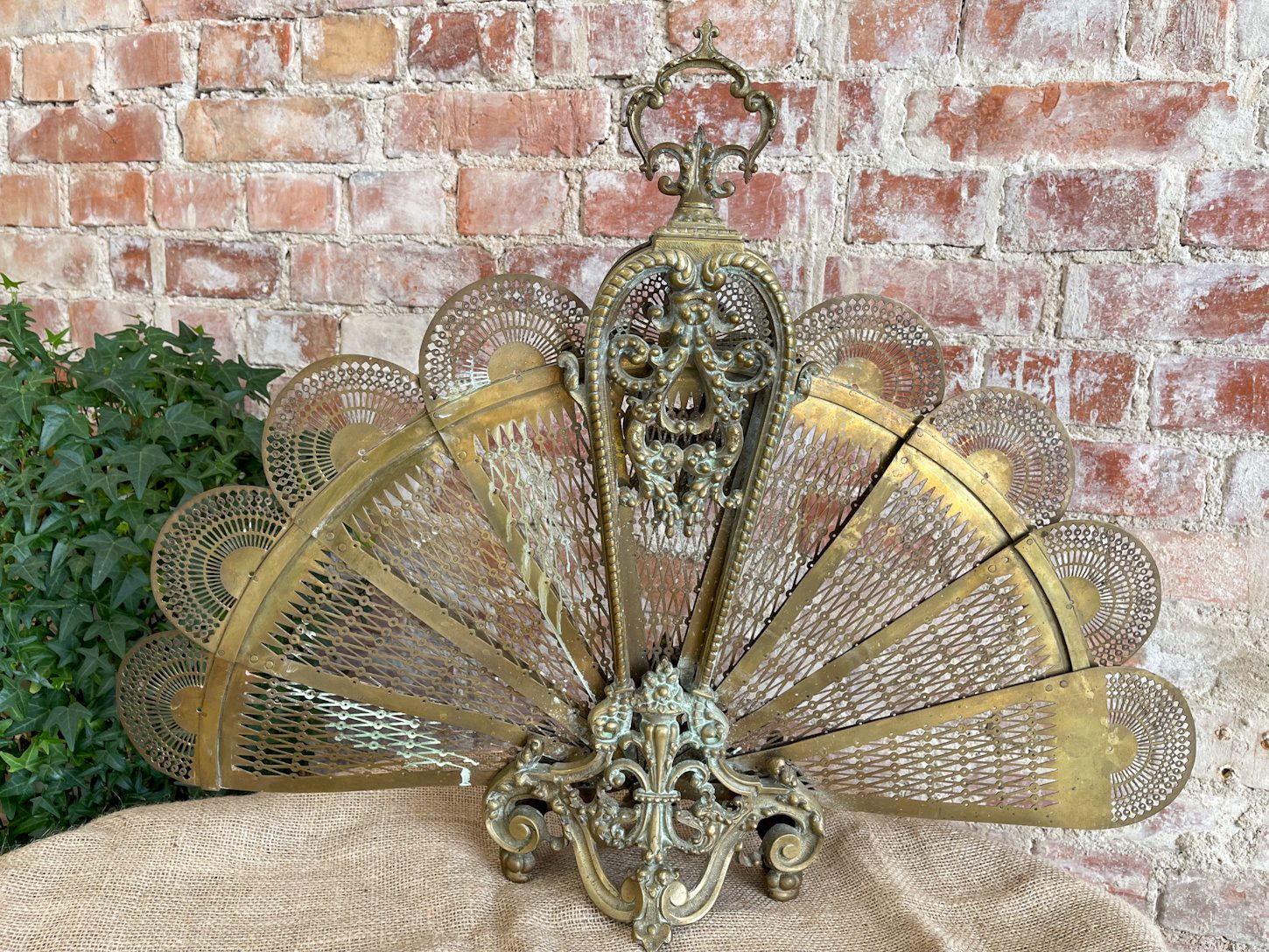
Позолоченный бронзовый складной каминный веер (ширма-павлин), стиль Наполеона III
Высота 61 cm Ширина 26 cm
Описание
Складной каминный веер из золочёной бронзы (павлиний экран) — стиль Наполеона III, Франция, вторая половина XIX века
Этот эффектный каминный веер (peacock firescreen) — изысканная работа из золочёной бронзы в духе Наполеона III и возрождения рококо. Его остроумный механизм позволяет семи ажурным, перфорированным бронзовым лопастям раскрываться в форме павлиньего хвоста или складываться вместе, как веер. Центральную стойку венчает тонкий маскарон (гротескное лицо) и ручка-волюта, всё опирается на ажурный постамент rocaille с вьющимися ножками-волютами. Каждая лопасть украшена тонкой, кружевоподобной перфорацией, отбрасывающей на свету узорчатую тень.
Высота 61 см · ширина (в сложенном виде) 26 см · ширина (в раскрытом виде) 80 см
Веер датируется второй половиной XIX века, эпохой Наполеона III, когда во Франции процветало возрождение рококо и различных исторических стилей. Такие каминные экраны в форме павлиньего веера были и декоративны, и практичны: они закрывали пустую топку летом и задерживали искры, служа одновременно элегантным акцентом интерьера.
Снимок Второй империи: дама в платье из зелёного шёлка наклонилась к камину перед приходом гостей и одним прикосновением раскрыла бронзовый веер во всю ширь. Свет газовой лампы дробился сквозь ажурные лопасти на сотни крошечных звёздочек на паркете. Она улыбнулась удовлетворённо — салон был готов. За шторами уже слышался стук первого экипажа по мостовой.
Без клейма; качество механизма, тонкость перфорации лопастей и моделировка маскарона указывают на хорошую французскую мастерскую bronzier второй половины XIX века. Складные каминные веера-экраны с полностью работающим механизмом и всеми сохранившимися лопастями сегодня встречаются нечасто — лопасти легко сгибаются или теряются, а механизм со временем заедает.
Веер служит перед камином как декоративный экран, но также как самостоятельный скульптурный акцент на краю камина или консоли. Золотистое сияние и форма павлиньего хвоста образуют театральную, фотогеничную деталь в интерьерной фотографии. Это впечатляющий подарок владельцу камина, ценителю антиквариата или дизайнеру интерьера.
Сохранены механизм, лопасти и постамент; возможны потёртости золочения и патина, мелкие изгибы лопастей или реставрации, соответствующие возрасту. Состояние предмета полностью отражено на фотографиях.
Folding Gilt-Bronze Peacock Firescreen — Napoleon III Style, France, Second Half of the 19th Century
This striking peacock firescreen is a refined work of gilt-bronze in the spirit of Napoleon III and the rococo revival. Its ingenious mechanism lets seven pierced, openwork bronze blades spread into the form of a peacock’s tail or fold together like a fan. The central shaft is crowned by a fine mascaron (grotesque face) and a volute handle, all resting on a pierced rocaille base with scrolling volute feet. Each blade is decorated with fine, lace-like piercing that casts a patterned shadow in the light, the very feature that gives this peacock firescreen its theatrical effect.
Height 61 cm · width (folded) 26 cm · width (extended) 80 cm
The fan dates to the second half of the 19th century, the time of Napoleon III, when the revival of rococo and various historical styles flourished in France. Such peacock-fan fire screens were both decorative and practical: they closed an empty hearth in summer and held back sparks, while serving as an elegant interior accent. Unmarked, the quality of the mechanism, the fineness of the blade piercing and the modelling of the mascaron point to a good bronzier workshop of the second half of the 19th century.
Second Empire snapshot: a lady in a green silk dress bent towards the fireplace before the guests arrived and with a single touch spread the bronze fan to its full width. The gaslight broke through the pierced blades into hundreds of tiny stars on the parquet. She smiled, satisfied — the salon was ready. Behind the curtains the first carriage could already be heard on the cobbles.
Folding peacock-fan fire screens with a fully working mechanism and all their blades preserved are not easily found today, as the blades are easily bent or lost and the mechanism stiffens with time. The fan serves before the fireplace as a decorative screen, but also as a sculptural accent in its own right on a mantel edge or console. Its golden glow and peacock-tail form make a theatrical, photogenic detail in interior photography, and an impressive gift for the fireplace owner, the lover of antiques or the interior designer. The mechanism, blades and base are preserved; gilding wear and patina, minor blade bends or restorations consistent with age are possible. The condition is fully reflected in the photographs.
Klappbarer Kaminfächer aus vergoldeter Bronze (Pfauenschirm) — Napoleon-III-Stil, Frankreich, zweite Hälfte des 19. Jahrhunderts
Dieser eindrucksvolle Kaminfächer (peacock firescreen) ist eine erlesene Arbeit aus vergoldeter Bronze im Geist von Napoleon III und der Rokoko-Wiederbelebung. Sein sinnreicher Mechanismus lässt sieben durchbrochene Bronzeblätter sich in Form eines Pfauenschweifs entfalten oder wie einen Fächer zusammenklappen. Den zentralen Schaft krönt ein feiner Maskaron (groteskes Gesicht) und ein Volutengriff, alles ruhend auf einem durchbrochenen Rocaille-Sockel mit geschwungenen Volutenfüßen. Jedes Blatt ist mit feiner, spitzenartiger Durchbrechung verziert, die im Licht einen gemusterten Schatten wirft.
Höhe 61 cm · Breite (zusammengeklappt) 26 cm · Breite (ausgeklappt) 80 cm
Der Fächer datiert in die zweite Hälfte des 19. Jahrhunderts, die Zeit Napoleons III, als in Frankreich die Wiederbelebung des Rokoko und verschiedener historischer Stile aufblühte. Solche Pfauenfächer-Kaminschirme waren zugleich dekorativ und praktisch: sie schlossen im Sommer eine leere Kaminöffnung und hielten Funken zurück, während sie als eleganter Interieurakzent dienten. Ohne Marke; die Qualität des Mechanismus, die Feinheit der Blattdurchbrechung und die Modellierung des Maskarons deuten auf eine gute französische bronzier-Werkstatt der zweiten Hälfte des 19. Jahrhunderts.
Momentaufnahme des Second Empire: eine Dame im Kleid aus grüner Seide beugte sich vor dem Eintreffen der Gäste zum Kamin und entfaltete mit einer einzigen Berührung den Bronzefächer in seine volle Breite. Das Gaslicht brach durch die durchbrochenen Blätter in Hunderte winziger Sterne auf dem Parkett. Sie lächelte zufrieden — der Salon war bereit. Hinter den Vorhängen war schon die erste Kutsche auf dem Pflaster zu hören.
Klappbare Pfauenfächer-Kaminschirme mit voll funktionierendem Mechanismus und allen erhaltenen Blättern sind heute schwer zu finden, da die Blätter leicht verbogen werden oder verloren gehen und der Mechanismus mit der Zeit klemmt. Der Fächer dient vor dem Kamin als dekorativer Schirm, aber auch als skulpturaler Akzent für sich auf einer Kaminkante oder Konsole. Sein goldener Schimmer und die Pfauenschweif-Form bilden ein theatralisches, fotogenes Detail in der Interieurfotografie. Ein eindrucksvolles Geschenk für den Kaminbesitzer, den Liebhaber von Antiquitäten oder den Innenarchitekten. Mechanismus, Blätter und Sockel sind erhalten; Vergoldungsabrieb und Patina, kleine Blattverbiegungen oder Restaurierungen entsprechend dem Alter sind möglich. Der Zustand ist in den Fotografien vollständig wiedergegeben.
Éventail de cheminée pliant en bronze doré (écran paon) — style Napoléon III, France, seconde moitié du XIXᵉ siècle
Ce saisissant éventail de cheminée (peacock firescreen) est une œuvre raffinée en bronze doré dans l’esprit de Napoléon III et du renouveau du rococo. Son ingénieux mécanisme permet à sept lames de bronze ajourées de se déployer en forme de queue de paon ou de se replier comme un éventail. Le fût central est couronné d’un fin mascaron (visage grotesque) et d’une poignée à volute, le tout reposant sur un socle rocaille ajouré à pieds en volute enroulés. Chaque lame est ornée d’une fine perforation en dentelle qui projette à la lumière une ombre ornementée.
Hauteur 61 cm · largeur (replié) 26 cm · largeur (déployé) 80 cm
L’éventail date de la seconde moitié du XIXᵉ siècle, l’époque de Napoléon III, lorsque le renouveau du rococo et de divers styles historiques s’épanouit en France. De tels écrans de cheminée en éventail de paon étaient à la fois décoratifs et pratiques : ils fermaient l’âtre vide en été et retenaient les étincelles, tout en servant d’élégant accent d’intérieur. Sans estampille, la qualité du mécanisme, la finesse de la perforation des lames et la modélisation du mascaron désignent un bon atelier de bronzier de la seconde moitié du XIXᵉ siècle.
Instantané du Second Empire : une dame en robe de soie verte se pencha vers la cheminée avant l’arrivée des invités et, d’un seul geste, déploya l’éventail de bronze dans toute sa largeur. La lumière du gaz se brisait à travers les lames ajourées en des centaines de petites étoiles sur le parquet. Elle sourit, satisfaite — le salon était prêt. Derrière les rideaux, on entendait déjà la première voiture sur les pavés.
Les écrans de cheminée pliants en éventail de paon, au mécanisme pleinement fonctionnel et aux lames toutes conservées, sont aujourd’hui difficiles à trouver, car les lames se plient ou se perdent aisément et le mécanisme se grippe avec le temps. L’éventail sert devant la cheminée comme écran décoratif, mais aussi comme accent sculptural à part entière sur un bord de cheminée ou une console. Sa lueur dorée et sa forme de queue de paon forment un détail théâtral et photogénique en photographie d’intérieur. Un cadeau impressionnant pour le propriétaire d’une cheminée, l’amateur d’antiquités ou le décorateur d’intérieur. Le mécanisme, les lames et le socle sont conservés ; usure de la dorure et patine, légères torsions des lames ou restaurations conformes à l’âge sont possibles. L’état est entièrement reflété dans les photographies.